Sean Dawn

a productivity app for the mind that won't stop

UX research & design 10 weeks Figma, FigJam Emily Carr University
01 — the spark

The Problem

I watched someone I know — smart, capable, fully aware of what he needed to do — spend 40 minutes every morning thinking about starting instead of actually starting. He'd check his phone, open three apps, reorganize his to-do list, and by the time he moved, half the morning was gone and the guilt had already set in.

He wasn't lazy. Once he started, he was fine. The problem lived in a very specific gap: the space between knowing what to do and doing it. That gap is where overthinking lives.

His thinking never stops, but without external structure it spins instead of moves.

Problem statement: an overthinker who thrives with external accountability but is paralyzed without it — productive when channeled, stuck when the time is open and the direction is his to choose.

A day in the life

6:45 AM
Wake up
Has clarity. Knows what to do.
hopeful
6:48 AM
Phone check
Opens Instagram, email, news.
distracted
7:10 AM
The spiral
Reorganizes to-do list. Again.
paralyzed
7:48 AM
Finally starts
38 min later. Guilt set in.
uncertain
12:00 PM
Working
Actually productive once started.
in flow
3:30 PM
Transition
Between tasks. Spiral returns.
uncertain
8:30 PM
Evening
No wind-down. Scrolls phone.
numb
10:00 PM
Sleep
Thinks about tomorrow. No capture.
anxious
02 — research

Understanding the Pattern

I needed to know if this was one person's quirk or a shared pattern. I conducted an in-depth interview with Sean and supplemented it with online research — forum threads, app store reviews, articles on overthinking and task initiation — to see if others experienced the same friction.

38 min avg delay from intention to action each morning
2.4 apps opened before starting the intended task
no system for deciding what to do first
once started he was fine — the first 2 min were the only hard part

The most important finding: once Sean started, he was fine. The first two minutes were the only hard part. Online research confirmed this pattern was widespread — forums and reviews were full of people describing the same gap. I wasn't designing a productivity system. I was designing a starter.

Persona
Sean · 31 · Vancouver, BC
occupationfreelance design student typeknowledge worker
"I spend more time thinking about what to do than actually doing anything."
self-aware overthinker values intentionality tool hopper
goals
Start within 5 min of deciding
One clear priority each morning
Build self-awareness over time
Feel present, not just productive
A system that stays simple
frustrations
Over 30 min lost every morning
To-do lists make it worse
Phone is a distraction gateway
Guilt spiral compounds
Tools abandoned in 2 weeks

Affinity themes

I grouped observations from Sean's interview and online research in FigJam. Six clusters emerged:

Analysis Paralysisthe morning spiral
Decision Fatiguetoo many open loops
Momentumonce started, he's fine
Tool Frustrationexisting apps make it worse
Self-Awarenessknows it's happening, can't stop
Accountabilityexternal push works, self-imposed doesn't

The "Tool Frustration" theme was telling. Sean had tried Notion, Todoist, Asana — every one gave him more choices at the exact moment he needed fewer. The tools were making the problem worse. Online research confirmed the same complaint across forums and app reviews.

Competitive positioning

I mapped the productivity space on two axes: more features vs. fewer features, planning-oriented vs. doing-oriented. Most tools clustered together — many features, heavy on planning. The opposite corner — fewer features, biased toward doing — was almost empty. That's where Sean Dawn would live.

MORE FEATURESFEWER FEATURES PLANNINGDOING Asana Notion Todoist Cal.com Be Focused Forest Finch Headspace Sean Dawn
How might we make getting started feel so small that overthinking doesn't kick in?
03 — design process

From Map to Prototype

01
Experience mapping
Mapped a full-day flow across 8 phases with decision points, alternate paths, and drop-off moments.
02
Navigation exploration
Compared four mobile patterns. Chose the progressive single-screen model — one screen that transforms, no nav bar, no escape routes.
03
Lo-fi wireframes
Sketched each phase. Tested the constraint: can the user complete each phase in under 3 taps?
04
Hi-fi wireframes
Built in Figma — warm gold for mornings, dark charcoal for focus, deep indigo for evening. The color of the screen tells you where you are.
05
Usability testing
Tested with 3 participants. Identified 3 friction points in onboarding, priority selection, and the reflection screen.
06
Iteration
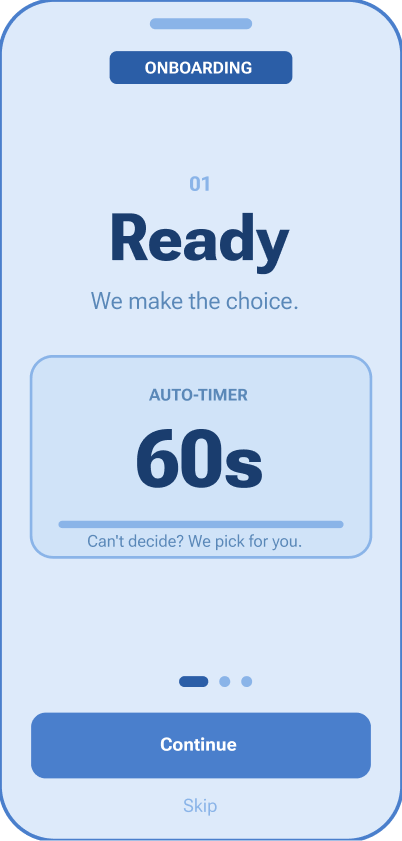
Simplified onboarding from 5 steps to 3, added an auto-commit timer, reduced reflection to a single tap.

The key iteration: auto-commit

When participants reached the morning priority screen, they stalled — even with only 2–3 options. The very problem the app was meant to solve was happening inside the app.

The fix: a 60-second auto-commit timer. If the user doesn't choose within a minute, the app chooses for them. One tester said: "Knowing it would pick for me actually made it easier to pick myself."

04 — the solution

One Screen, All Day

Sean Dawn is a mobile app built on one principle: fewer choices at the right moment. No tab bar, no settings rabbit hole, no feature grid. One screen that transforms based on the time of day.

8 phases

01Capture3AM idea safe-keeping
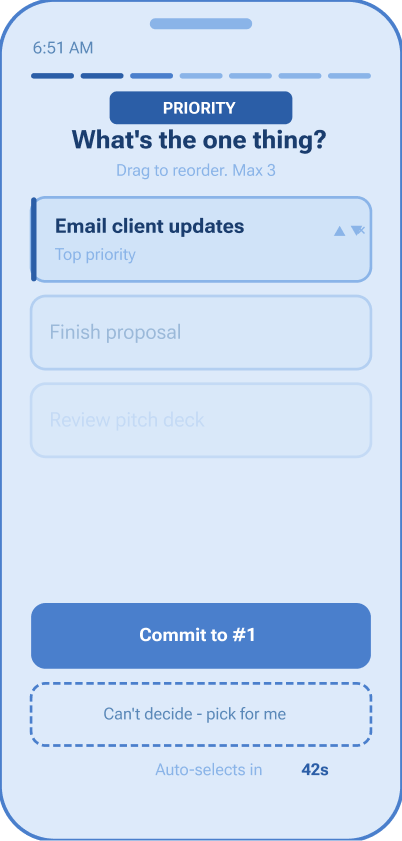
02Priorityone thing, 60s timer
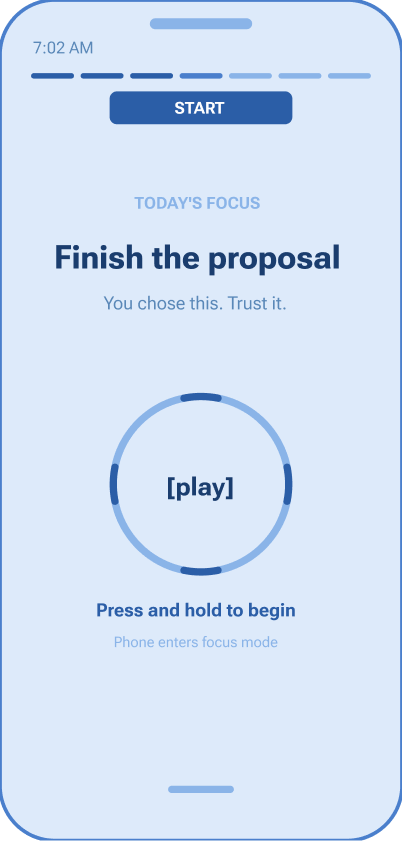
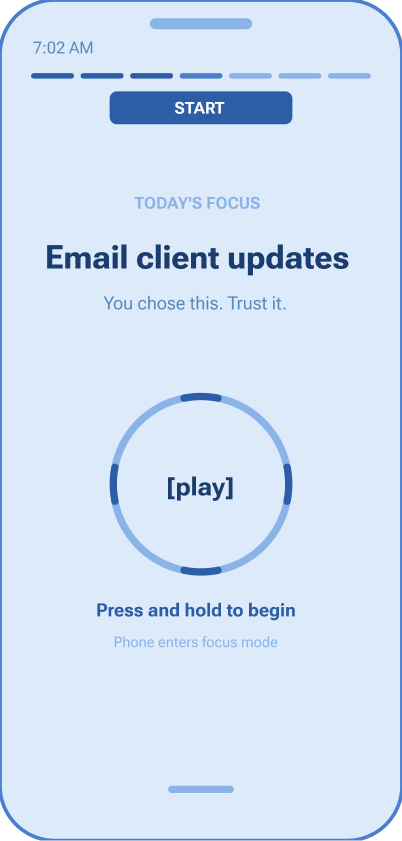
03Startswipe to commit
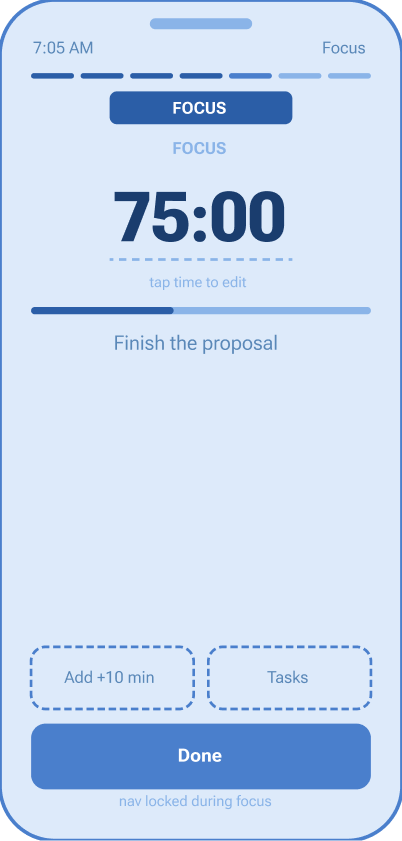
04Focuslocked, nav disabled
05Extend+10 min increments
06Unwindbreak timer, step away
07Reflectmoved, mixed, or spun
08Intentionset tomorrow, loop

Onboarding

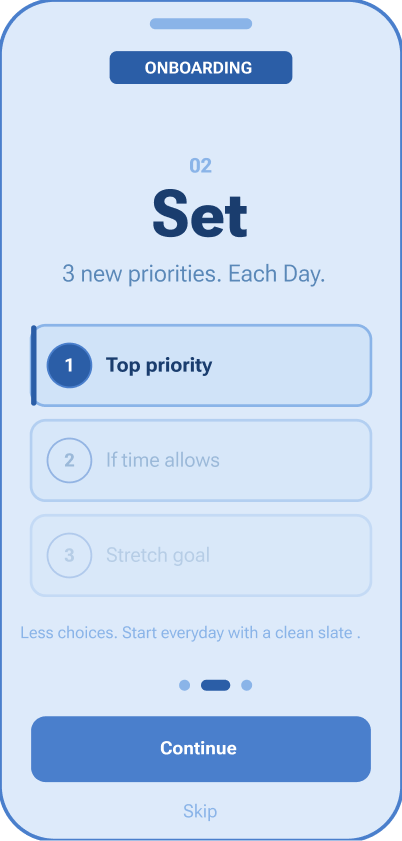
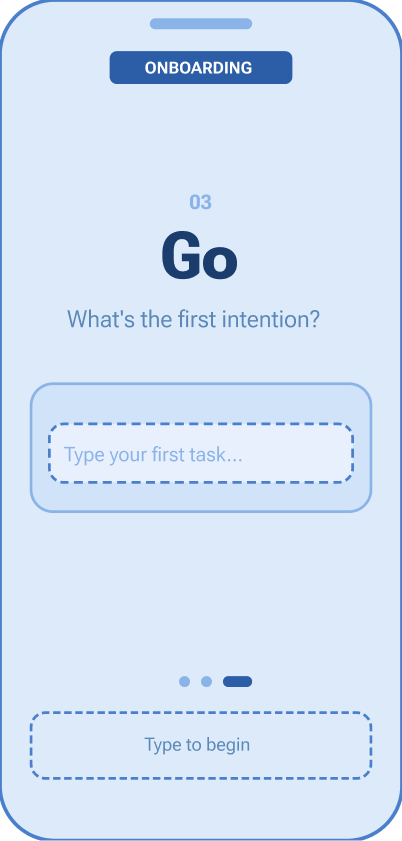
Onboarding step 1: Ready — auto-timer 60s, we make the choice Onboarding step 2: Set — 3 priorities, that's it Onboarding step 3: Go — what's the first intention?
onboarding — ready, set, go. three screens, under 15 seconds.

Capture

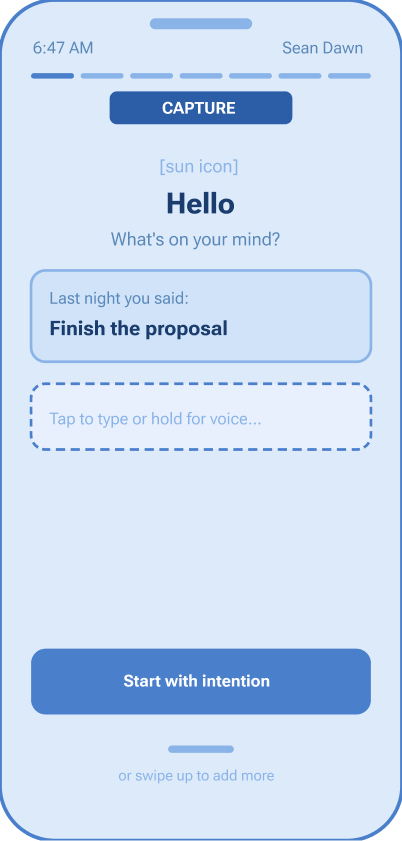
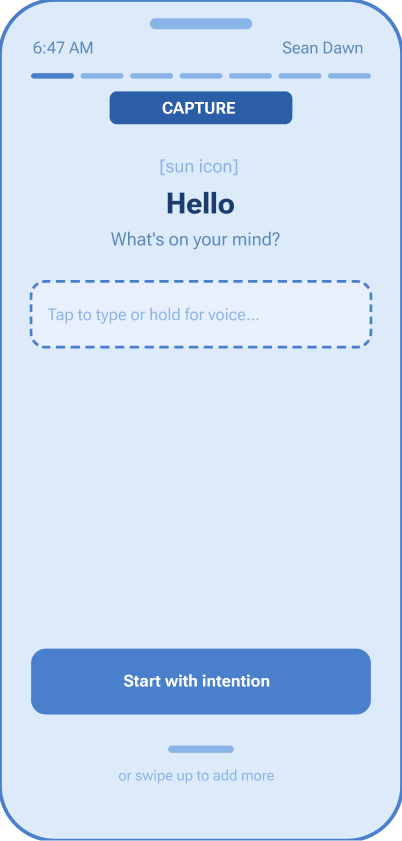
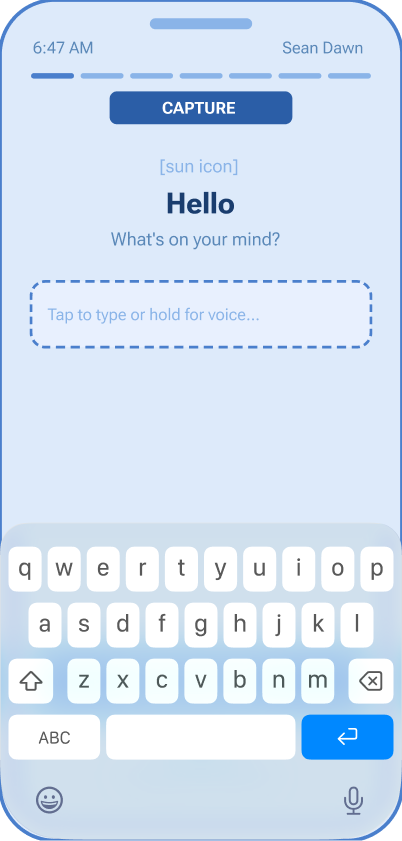
Capture screen with last night's intention surfaced Capture screen — blank input for new thoughts Capture screen with keyboard open
capture — morning greeting with last night's intention or a blank slate

Interrupt

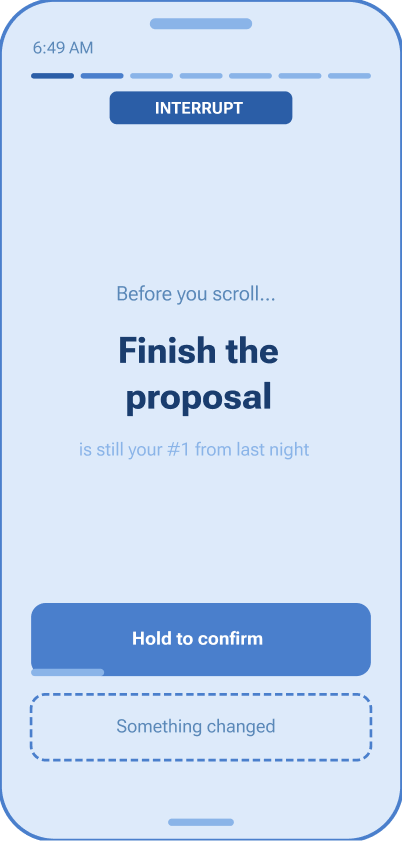
Interrupt screen — before you scroll, finish the proposal is still your #1
interrupt — before you scroll, your #1 from last night is waiting

Prioritize + Start

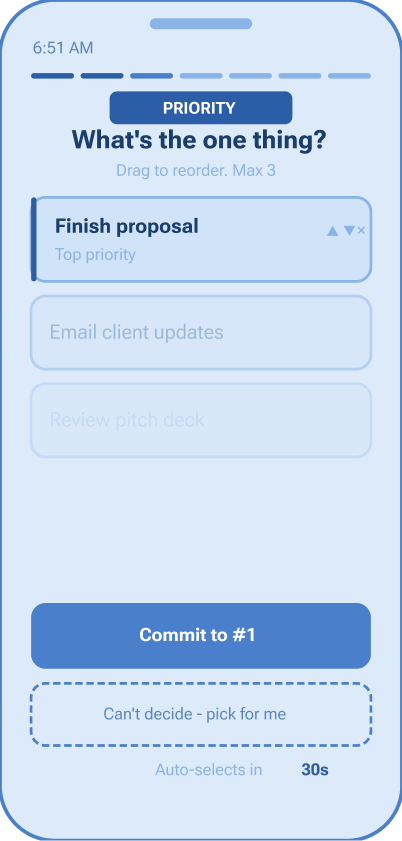
Priority screen — finish proposal as top priority Priority screen — reordered, email client updates now top
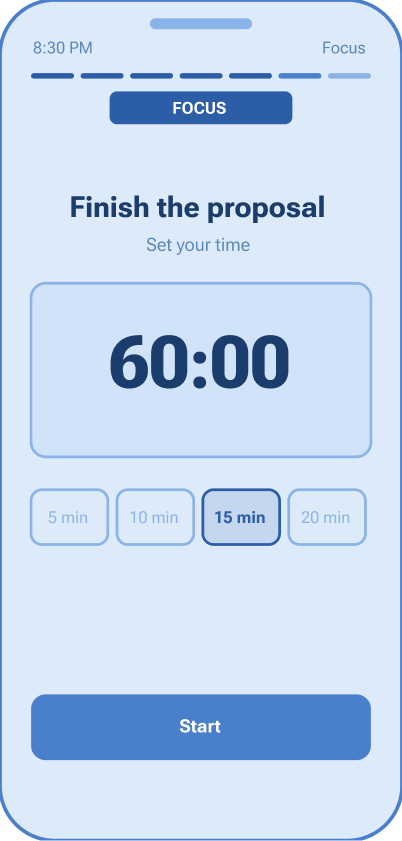
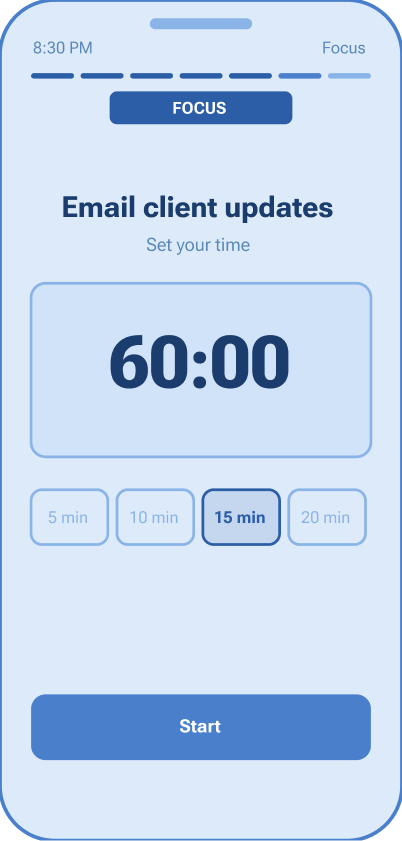
Start screen — finish the proposal, press and hold to begin Start screen — email client updates, press and hold to begin
prioritize → reorder → commit — auto-selects if you can't decide

Focus

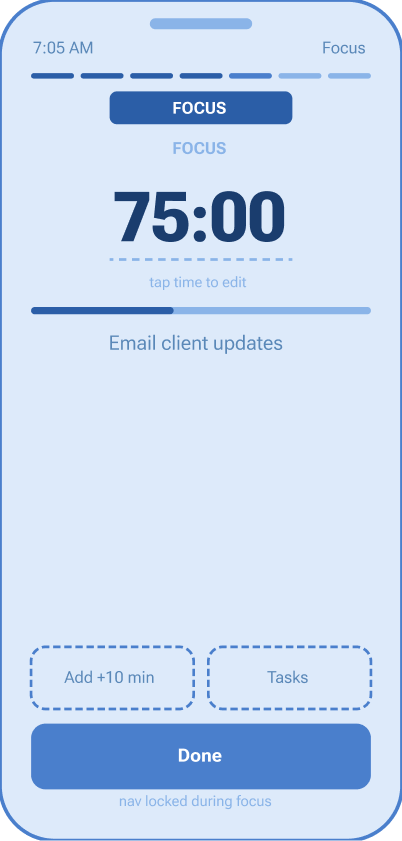
Focus screen — 75 min timer, finish the proposal, nav locked Focus screen — email client updates task
focus — timer running, nav locked, only options: +10 min, tasks, or done

Unwind

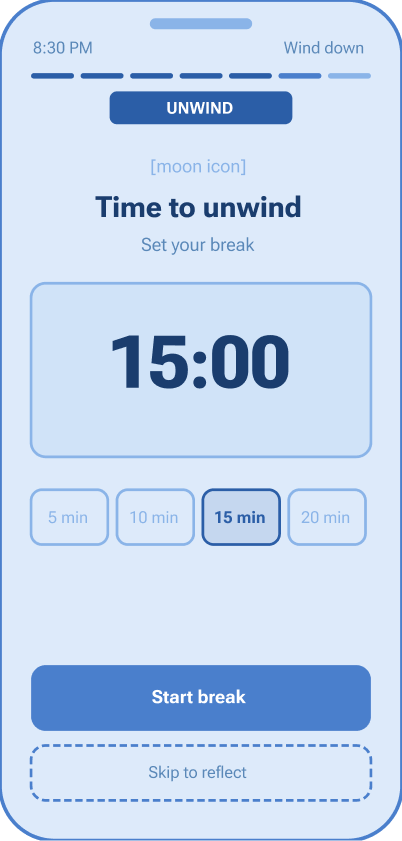
Unwind screen — time to unwind, set your break to 15 min Unwind screen — set your break length before starting Unwind screen — email client updates, set your break time
unwind — choose your break length, or skip straight to reflect

Reflect

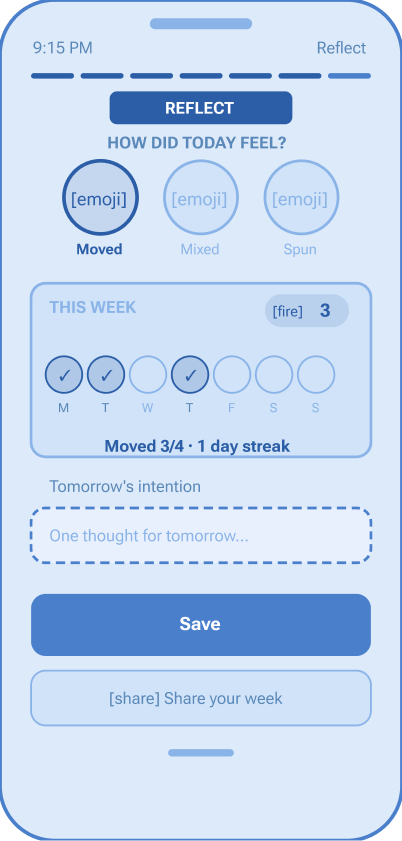
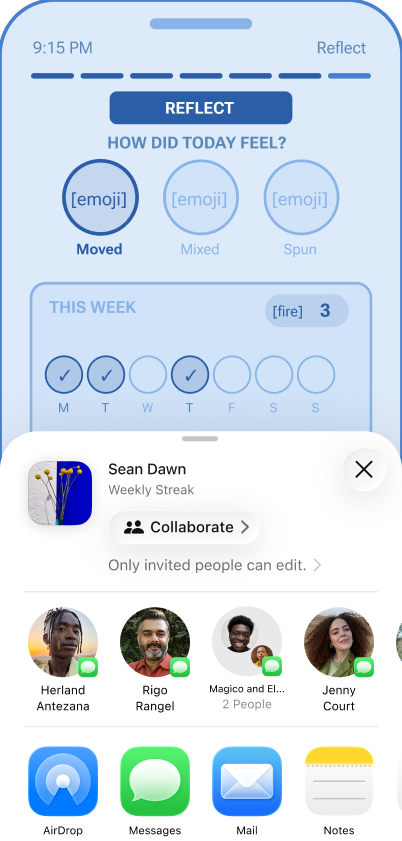
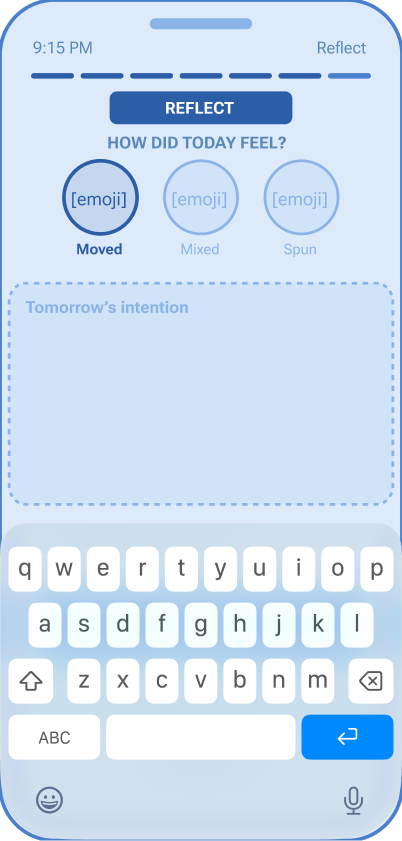
Reflect screen — how did today feel, weekly dots, tomorrow's intention Reflect screen — keyboard open for tomorrow's intention Reflect screen — share your week via iOS share sheet
reflect — one tap check-in, weekly pattern, share your streak

Design principles

Fewer choices at the right moment. Max 3 items on the priority screen. Auto-commit at 60 seconds. The app decides if you don't.

Gestures as rituals. Swipe down to commit. Hold to extend focus. Tap to reflect. Physical gestures create intention that button presses don't.

The screen is the clock. Warm gold in the morning. Dark charcoal during focus. Deep indigo at night. You always know where you are without reading a word.

No escape routes. During focus mode, navigation is locked. The only options: extend, view tasks, or done.

The reflection loop

End of day, one question: how did today feel? Three options, one tap.

Moved Mixed Spun

Not good or bad. Moved means you started and stayed present. Spun means overthinking won. Mixed is most days. Over time, the weekly dots build a pattern — no journaling, no analytics dashboard, just one honest signal each day.

M
T
W
T
F
S
S
~
×
moved 4/6 · 3 day streak · week of apr 7
05 — outcomes

What Testing Showed

Full flow
Capture
!
Interrupt
1
Priority
Start
Focus
Next
Unwind
Reflect
6:45 AMmorningfocustransition9:15 PM
beforeafter
38 min morning delayunder 5 min to first task
2.4 apps before starting1 screen, no switching
no system for prioritizingauto-commit removes the decision
guilt spiral compounds dailydaily reflection builds self-proof
self-aware but stuck in the looppattern visible in weekly dots

All 6 test participants completed the core flow — capture, prioritize, start, reflect — without guidance. Onboarding took under 15 seconds after being simplified from 5 screens to 3. The auto-commit timer was the most discussed feature: initially surprising, then universally appreciated.

Every productivity app gives you more. Sean Dawn gives you less — because the problem was never doing the work. It was starting it.
06 — reflection

What I'd Do Differently

The research was one interview and secondary sources — directional, not definitive. A larger participant pool and a diary study would capture real-time behavior rather than recall. The color-shifting screen also needs iconography and haptic feedback alongside color — state shouldn't live in color alone.

What this taught me

The biggest lesson was restraint. Every instinct as a designer is to add — more features, more options, more flexibility. Sean Dawn forced me to do the opposite. The hardest screen to design wasn't the most complex one. It was the one with almost nothing on it.
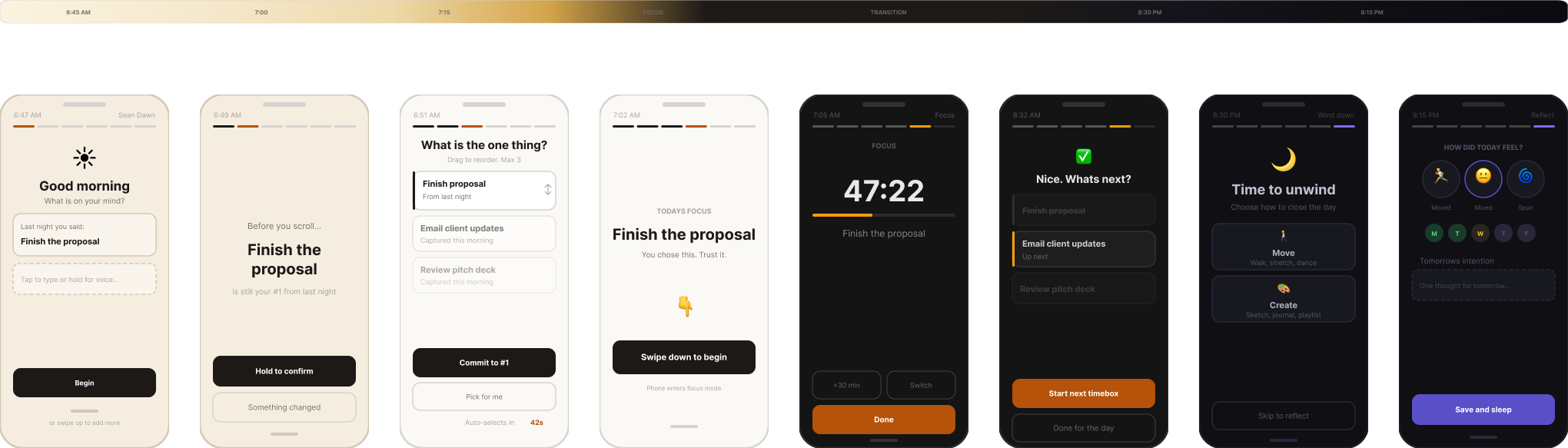
High-fidelity mockup of Sean Dawn's daily screen — the single screen that shifts through the day.